

From Adrian Shaughnessy and Tony Brook comes Unit Editions, a south London publishing company producing books on design and visual culture.
Multi award winning Tony Brook is known for work produced through his design studio Spin. Much of the work has been exhibited globally and documented in many publications including Graphic Design for the 21st Century. Tony is president of the UK chapter of AGI.
Adrian Shaughnessy has authored many titles including How to be a Graphic Designer Without Losing Your Soul and Graphic Design: A User’s Manual. He is also host of the internet radio show Graphic Design on the Radio.
I talked with Adrian Shaughnessy to get up to speed with what’s in store at Unit Editions.
Theo Rosendorf: What topics does Unit Editions deal in?
Adrian Shaughnessy: Our ambition is to produce books on a wide variety of topics relating to graphic design and visual culture. I can’t see us producing books on how to use software packages, but I’d hate to rule out any topic that was of interest to designers.
Amongst other things, we have an ambition to publish books on historical subjects. There is a disconnect when it comes to design history. If you talk to mainstream publishers – even those with extensive back catalogues of design books – they will tell you that historical subjects don’t sell. We’re not convinced. I think the failure of historical titles has got more to do with the way publishers put these books together: they are often badly designed and written purely for an academic audience. Dull, in a word.
Poor sales can’t be because there isn’t any interest in the history of graphic design. Look at the internet – it’s stuffed with examples of historical material. One of the ways we’ve driven people to the Unit Editions website is through a Flickr site that Tony has been building up. He is a collector and has an archive of fantastic journals, magazines, books and posters by Swiss, Dutch, German, and American designers. From time to time he dips into this trove and plucks out a few unseen gems and posts them on Flikr. The effect is astonishing. Within minutes people are responding – and many of these hardcore design fans find their way onto the Unit site.

Besides historical subjects, we want to look at the contemporary scene, too. We’ve got an important book lined up for next year that we’ll be announcing soon. The subject matter is contemporary, but we want to show that what is cool and vibrant now often has links with what was cool and vibrant in the past – so the book will encompass the contemporary and the historical.
We’re also committed to publishing books by designers and writers we admire. We want other voices and other opinions to enter the Unit bloodstream. But whatever we do, our books will always be characterised by superb design and production. Each of our books will be an embodiment of the ethos that underpins Unit – namely that design is our paramount, first and number one concern.
I imagine you’re preparing for an onslaught of query letters. How do you select books for publication?
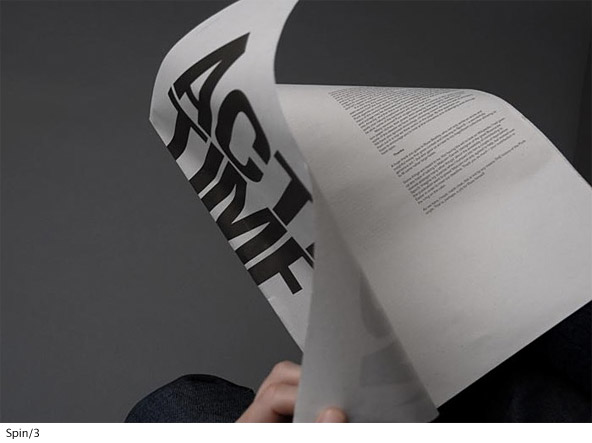
Well, its still early days for us. We have no track record to help us decide what books will find a market, so we are relying on our intuition and the experience we have gained from publishing material ourselves. Tony has produced three issues of a journal called Spin [link through Spin’s studio projects] and he has sold lots of these. I’ve done about 8–9 books with a commercial publisher and all of them have been successful – some more so than others. We both spend a lot of time in design schools, we both read the design press, the blogs, and the literature of graphic design. In addition we both have an extensive network for friends and contacts in all areas of design.
So, I would say we have a good grasp of what designers want from books. But in the end it comes down to our intuition. We want to publish books that we would like to see in print – and that’s the main way we are arriving at a decision about the books we will publish.
Does Unit Editions have a physical location or is it completely web-based?
We are based at the Spin design studio in south London. It’s a delightful airy space. I’m there one or two days a week, but the rest of the time I’m based at my home studio. For writing and editing duties I need as few distractions as possible.
I agree. A hermetically sealed, climate controlled pod would be ideal. How much control does Unit Editions exercise with editing its publications?
Tony and me have both lived and worked as Creative Directors of design studios for most of our lives – Tony still does this, but I gave up studio life six years ago. As Creative Directors our philosophy is to designers as much freedom as possible, and only intervening when they go off track. Yet it is only possible to adopt a hands-off approach when you work with good people. If you employ second-rate designers then you have to intervene all the time.
It’s the same with the authors or the external designers we decide to work with on books. Editing is like being a Creative Director, it only works if your intervention is wanted and respected, so we’d only want to work with people who felt that our editorial or design interventions were welcome. If we were consonantly at war with an author or a designer then it probably wouldn’t be the sort of book we’d want to publish – although a bit of creative friction can often help reach a deeper and richer outcome.
In light of the internet and social mediums, what marketing and distribution channels do you use?
We are distributed in the UK, Europe and the US by major book distributors. They will get our books into bookshops and are the best in their fields. But we are also planning to sell special ‘designer’ editions of our books on our website. Our website is a blog – it’s a customized WordPress site, low cost but effective. We have a Facebook page and an active and well-attended Flickr site, as I’ve already mentioned. Against my instincts I am also going to start Tweeting – but I’m not entirely convinced by it as a platform so I’m just dipping my toes. At the moment our energies are going into the Unit website. We want to make it into an essential destination for designers – although we’ve got some pretty stiff competition in that area!
What are your thoughts on small vs dominant chain bookstores? Who do you prefer to stock with?
We are happy to be in any bookstore – physical or online – that wants to stock our books. But we’re keen to work with some of the smaller specialist shops. In the UK there is a wonderful mini-chain of shops selling design books called Magma. We know the owner really well, and he’s being incredibly supportive. He’s given us windows to promote Studio Culture in the weeks around its publication. We are also going to Amsterdam to give a talk at a wonderful book shop called Nijhof & Lee We’ll post details of this and other talks on our website.

We’ve been staggered by the number of books we’ve pre-sold from our website. The version we offer online is signed by Tony and me and it comes with a different cover from the version that is sold in the shops. It’s made us realise that we can build a publishing business that functions online as well as through conventional retail outlets. The discounts the chains demand are pretty horrendous, and by the time the distributor has taken their cut, there isn’t much left. I’d always want to see our books in bookstores – and I really hope bookstores don’t go the way of record shops and vanish – but in order to survive we are going to have to sell direct to our audience. And since our audience is designers, and since designers ‘live’ online, that means we have to use the internet.
What are your professional backgrounds?
Before founding our respective studios, both Tony and I worked separately for design companies doing record covers. Tony founded Spin in 1991 and is the studio’s Creative Director. He runs Spin in partnership with his wife Patricia Finegan, who is the business manager of Unit Editions. Spin has worked for numerous clients such as Channel 4, Nike and ICA. The studio has won countless awards, and has designed numerous books and publications, including the successful Spin [link through Spin’s studio projects] series of publications. He is president of the UK chapter of AGI, and is a recognised collector of graphic design artefacts. He lectures extensively around the world.
I co-founded the design studio Intro in 1989, but left to work as an independent art director and writer in 2003. I’ve written, edited and designed numerous books including How to be a Graphic Designer Without Losing Your Soul, which has sold 70,000 copies, and I’ve got a new book out called Graphic Design: A User’s Manual. I write for many design magazines, and I’m a contributor to Design Observer, the world’s most widely read design blog. I do a lot of lecturing all over the world.
What does Unit Editions currently have in the works?
Ah, that would be telling. Very competitive this publishing game! But we should be able to announce our next title in a month or two. It is more of an image book than Studio Culture, but it will have plenty of texts and interesting commentaries. It is about a graphic design topic that, amazingly, hasn’t been covered in book form yet. It is planned for publication in 2010. We have a long list of titles we are considering – watch this space!
ben
great stuff, and i completely agree that too many ‘design’ books from mainstream publishers are poorly designed and dull as dishwater. I’ll have to pop down to magma and check studio culture out for myself. for what it’s worth I’d love to see a collection of john gorham’s brought to print. he had some wonderful, charming, witty and inventive work and it’s a shame so little of it is out there in the public eye.
Creative Review - Design Museum takeover
[…] from Studio Culture, from Type Desk’s interview with Unit, […]